Early
Career
After the war ended in 1945, Hepburn moved with her mother and siblings to Amsterdam, where she began ballet training under Sonia Gaskell, a leading figure in Dutch ballet, and Russian teacher Olga Tarasova. Due to the loss of the family fortune, Ella had to support them by working as a cook and housekeeper for a wealthy family. Hepburn made her film debut playing an air stewardess in Dutch in Seven Lessons (1948), an educational travel film made by Charles van der Linden and Henry Josephson.
Later that year, Hepburn moved to London after accepting a ballet scholarship with Ballet Rambert, which was then based in Notting Hill. She supported herself with part-time work as a model, and dropped "Ruston" from her surname. After she was told by Rambert that despite her talent, her height and weak constitution (the after-effect of wartime malnutrition) would make the status of prima ballerina unattainable, she decided to concentrate on acting. While Ella worked in menial jobs to support them, Hepburn appeared as a chorus girl in the West End musical theatre revues High Button Shoes (1948) at the London Hippodrome, and Cecil Landeau's Sauce Tartare (1949) and Sauce Piquante (1950) at the Cambridge Theatre. Also, in 1950, she worked as a dancer in an exceptionally "ambitious" revue, Summer Nights, at Ciro's London, a prominent nightclub.
During her theatrical work, she took elocution lessons with actor Felix Aylmer to develop her voice. After being spotted by the Ealing Studios casting director, Margaret Harper-Nelson, while performing in Sauce Piquante, Hepburn was registered as a freelance actress with the Associated British Picture Corporation (ABPC). She appeared in the BBC Television play The Silent Village, and in minor roles in the films One Wild Oat, Laughter in Paradise, Young Wives' Tale, and The Lavender Hill Mob (all 1951). She was cast in her first major supporting role in Thorold Dickinson's Secret People (1952), as a prodigious ballerina, performing all of her own dancing sequences.
Hepburn then took a small role in a bilingual film, Monte Carlo Baby (French: Nous Irons à Monte Carlo, 1952), which was filmed in Monte Carlo. Coincidentally, French novelist Colette was at the Hôtel de Paris in Monte Carlo during the filming, and decided to cast Hepburn in the title role in the Broadway play Gigi. Hepburn went into rehearsals having never spoken on stage, and required private coaching. When Gigi opened at the Fulton Theatre on 24 November 1951, she received praise for her performance, despite criticism that the stage version was inferior to the French film adaptation. Life called her a "hit", while The New York Times stated that "her quality is so winning and so right that she is the success of the evening". Hepburn also received a Theatre World Award for the role. The play ran for 219 performances, closing on 31 May 1952, before going on tour, which began 13 October 1952 in Pittsburgh and visited Cleveland, Chicago, Detroit, Washington, D. C., and Los Angeles, before closing on 16 May 1953 in San Francisco.
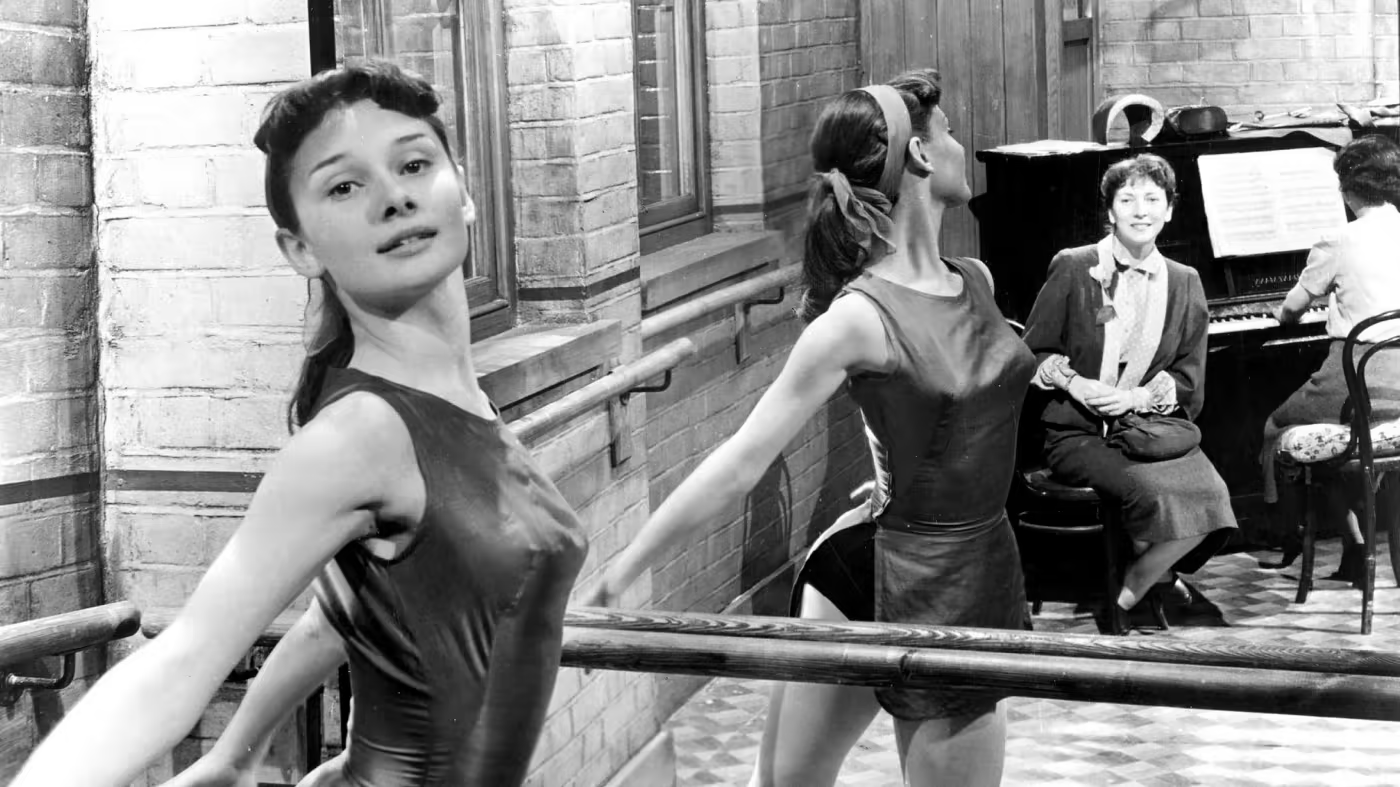
Audrey Hepburn in Secret People, 1952. (Everett Collection/Alamy)
Stardom
Hepburn had her first starring role in Roman Holiday (1953), playing Princess Ann, a European princess who escapes the reins of royalty and has a wild night out with an American newsman (Gregory Peck). On 18 September 1951, shortly after Secret People was finished but before its premiere, Thorold Dickinson made a screen test with the young starlet and sent it to director William Wyler, who was in Rome preparing Roman Holiday. Wyler wrote a glowing note of thanks to Dickinson, saying that "as a result of the test, a number of the producers at Paramount have expressed interest in casting her." The producers of the film had initially wanted Elizabeth Taylor for the role, but Wyler was so impressed by Hepburn's screen test that he cast her instead. Wyler later commented, "She had everything I was looking for: charm, innocence, and talent. She also was very funny. She was absolutely enchanting, and we said, 'That's the girl!'"
Originally, the film was to have had only Gregory Peck's name above its title, with "Introducing Audrey Hepburn" beneath in smaller font. Peck suggested Wyler elevate her to equal billing so her name appears before the title, and in type as large as his:
You've got to change that because she'll be a big star, and I'll look like a big jerk.
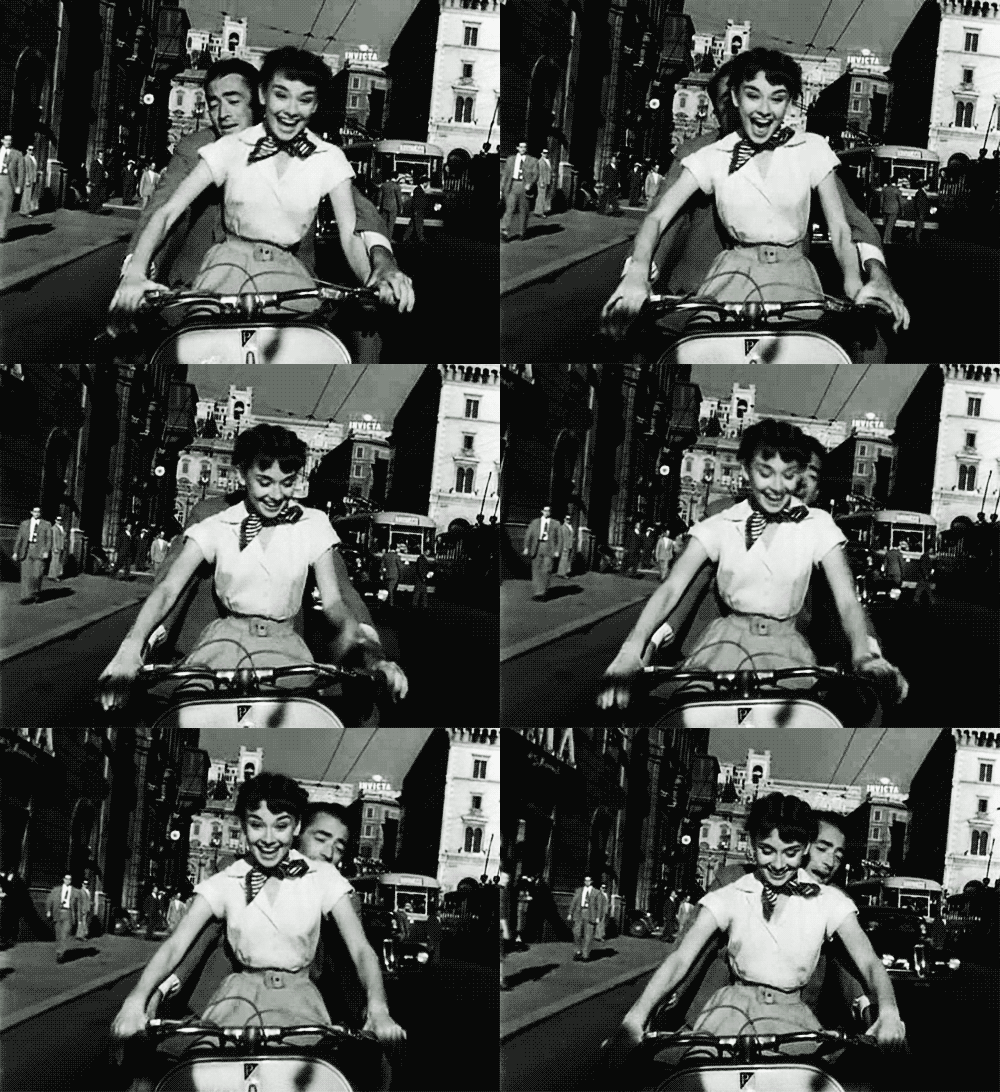
Audrey Hepburn in Roman Holiday, 1953.
The film was a box-office success, and Hepburn gained critical acclaim for her portrayal, unexpectedly winning an Academy Award for Best Actress, a BAFTA Award for Best British Actress in a Leading Role, and a Golden Globe Award for Best Actress – Motion Picture Drama in 1953. In his review in The New York Times, A. H. Weiler wrote: "Although she is not precisely a newcomer to films, Audrey Hepburn, the British actress who is being starred for the first time as Princess Anne, is a slender, elfin, and wistful beauty, alternately regal and childlike in her profound appreciation of newly-found, simple pleasures and love. Although she bravely smiles her acknowledgement of the end of that affair, she remains a pitifully lonely figure facing a stuffy future."
Hepburn was signed to a seven-picture contract with Paramount, with 12 months in between films to allow her time for stage work. She was featured on 7 September 1953 cover of Time magazine, and also became known for her personal style. Following her success in Roman Holiday, Hepburn starred in Billy Wilder's romantic Cinderella-story comedy Sabrina (1954), in which wealthy brothers (Humphrey Bogart and William Holden) compete for the affections of their chauffeur's innocent daughter (Hepburn). For her performance, she was nominated for the 1954 Academy Award for Best Actress, while winning the BAFTA Award for Best Actress in a Leading Role the same year. Bosley Crowther of The New York Times stated that she was "a young lady of extraordinary range of sensitive and moving expressions within such a frail and slender frame. She is even more luminous as the daughter and pet of the servants' hall than she was as a princess last year, and no more than that can be said."
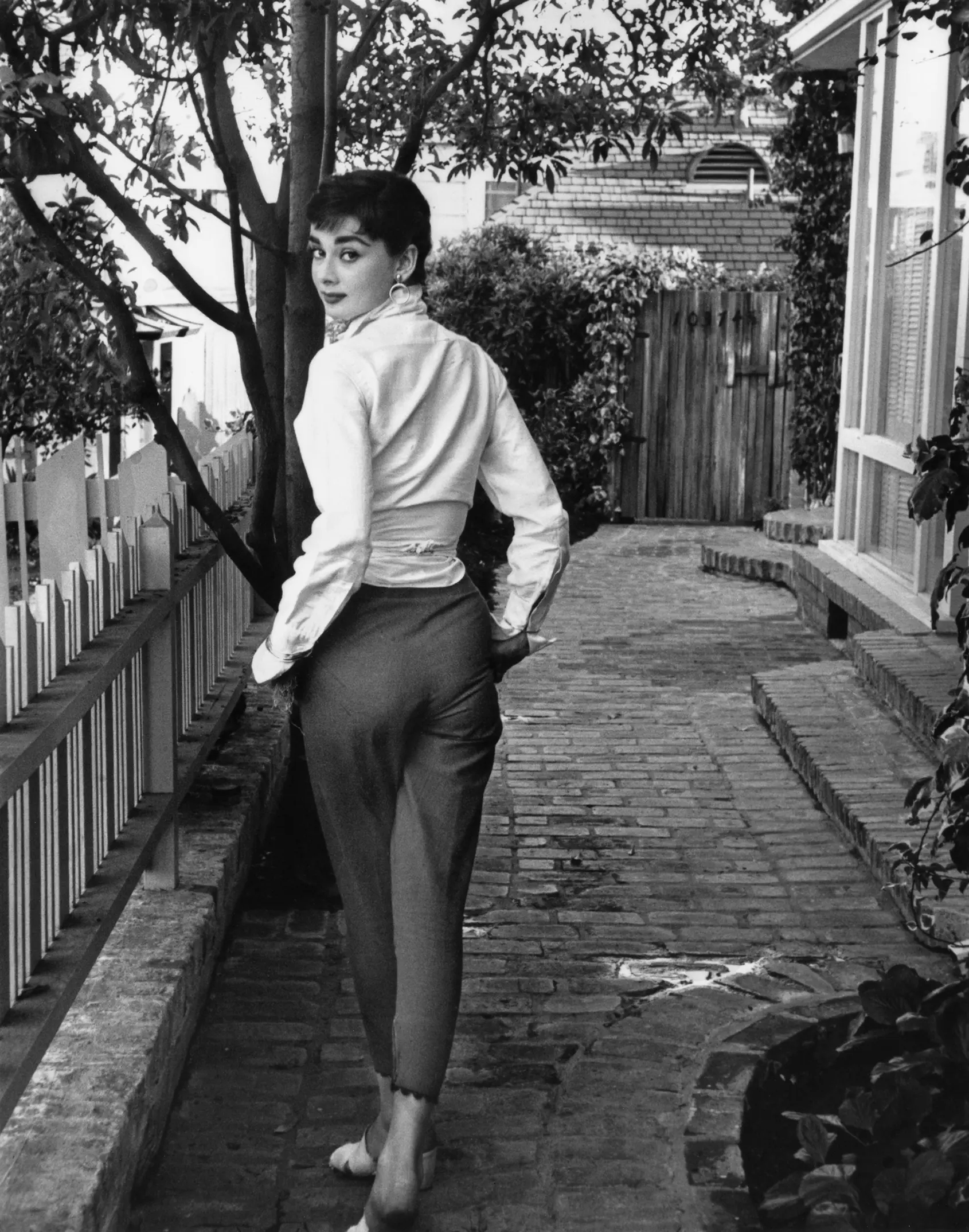
Audrey Hepburn on set during a Life magazine shoot, 1953. (Mark Shaw / mptvimages.com)
Although she appeared in no new film releases in 1955, Hepburn received the Golden Globe for World Film Favorite that year. Having become one of Hollywood's most popular box-office attractions, she starred in a series of successful films during the remainder of the decade, including her BAFTA- and Golden Globe-nominated role as Natasha Rostova in War and Peace (1956), an adaptation of the Tolstoy novel set during the Napoleonic wars, starring Henry Fonda and her husband Mel Ferrer. She exhibited her dancing abilities in her debut musical film, Funny Face (1957), wherein Fred Astaire, a fashion photographer, discovers a beatnik bookshop clerk (Hepburn) who, lured by a free trip to Paris, becomes a beautiful model. Hepburn starred in another romantic comedy, Love in the Afternoon (also 1957), alongside Gary Cooper and Maurice Chevalier.
Breakfast
at Tiffany's
Hepburn next starred as New Yorker Holly Golightly in Blake Edwards's Breakfast at Tiffany's (1961), a film loosely based on the Truman Capote novella of the same name. Capote disapproved of many changes that were made to sanitise the story for the film adaptation, and would have preferred Marilyn Monroe to have been cast in the role, although he also stated that Hepburn "did a terrific job". The character is considered one of the best-known in American cinema, and a defining role for Hepburn. The dress she wears during the opening credits has been considered an icon of the twentieth century, and perhaps the most famous "little black dress" of all time.
She was nominated for the Academy Award for Best Actress for her performance. Hepburn stated that the role was "the jazziest of my career".
I'm an introvert. Playing the extroverted girl was the hardest thing I ever did.
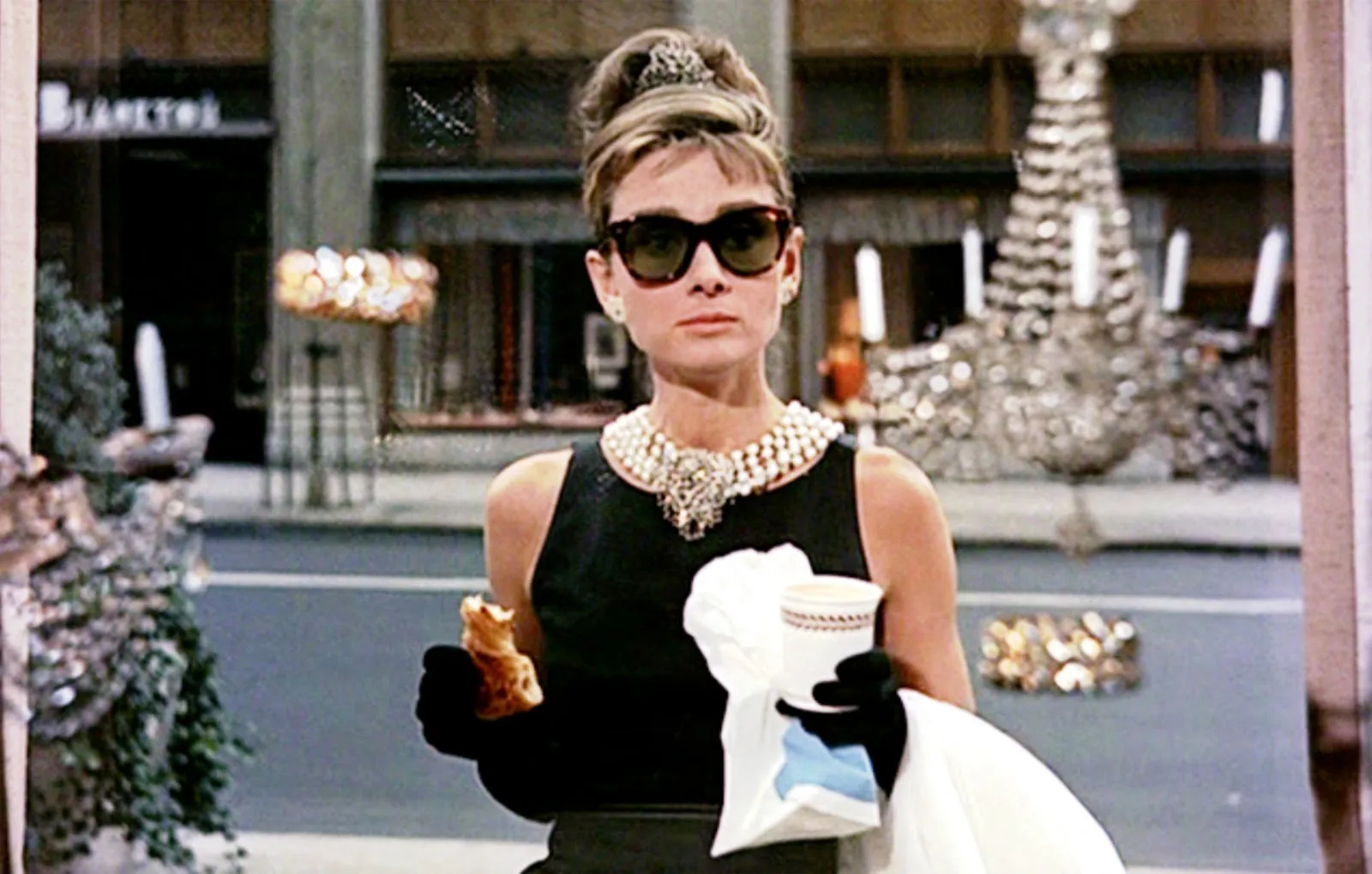
Audrey Hepburn in the opening credits of Breakfast at Tiffany's, 1961.
Final
Projects
After 1967, Hepburn chose to devote more time to her family and acted only occasionally. She attempted a comeback playing Maid Marian in the period piece Robin and Marian (1976) with Sean Connery co-starring as Robin Hood, which was moderately successful. Roger Ebert praised Hepburn's chemistry with Connery, writing, "Connery and Hepburn seem to have arrived at a tacit understanding between themselves about their characters. They glow. They really do seem in love. And they project as marvellously complex, fond, tender people; the passage of 20 years has given them grace and wisdom." Hepburn reunited with director Terence Young in the production of Bloodline (1979), sharing top-billing with Ben Gazzara, James Mason, and Romy Schneider. The film, an international intrigue amid the jet-set, was a critical and box-office failure. Hepburn's last starring role in a feature film was opposite Gazzara in the comedy They All Laughed (1981), directed by Peter Bogdanovich.
After finishing her last motion picture role—a cameo appearance as an angel in Steven Spielberg's Always (1989)—Hepburn completed only two more entertainment-related projects, both critically acclaimed. Gardens of the World with Audrey Hepburn was a PBS documentary series, which was filmed on location in seven countries in the spring and summer of 1990. A one-hour special preceded it in March 1991, and the series itself began its national PBS premiere on 24 January 1993, the day of her funeral services in Tolochenaz. For the "Flower Gardens" episode, Hepburn was posthumously awarded the 1993 Emmy Award for Outstanding Individual Achievement – Informational Programming. The other project was a spoken word album, Audrey Hepburn's Enchanted Tales, which features readings of classic children's stories and was recorded in 1992. It earned her a posthumous Grammy Award for Best Spoken Word Album for Children.