Legacy
Hepburn's legacy has endured long after her death. The American Film Institute named Hepburn third among the Greatest Female Stars of All Time. She is one of few entertainers who have won Academy, Emmy, Grammy and Tony Awards. She won a record three BAFTA Awards for Best British Actress in a Leading Role. In her last years, she remained a visible presence in the film world. She received a tribute from the Film Society of Lincoln Center in 1991 and she was a frequent presenter at the Academy Awards. She received the BAFTA Lifetime Achievement Award in 1992. She was the recipient of numerous posthumous awards including the 1993 Jean Hersholt Humanitarian Award and competitive Grammy and Emmy Awards. In January 2009, Hepburn was named on The Times' list of the top 10 British actresses of all time. In 2010, Emma Thompson opined that Hepburn "can't sing and she can't really act"; some people agreed, others disagreed.
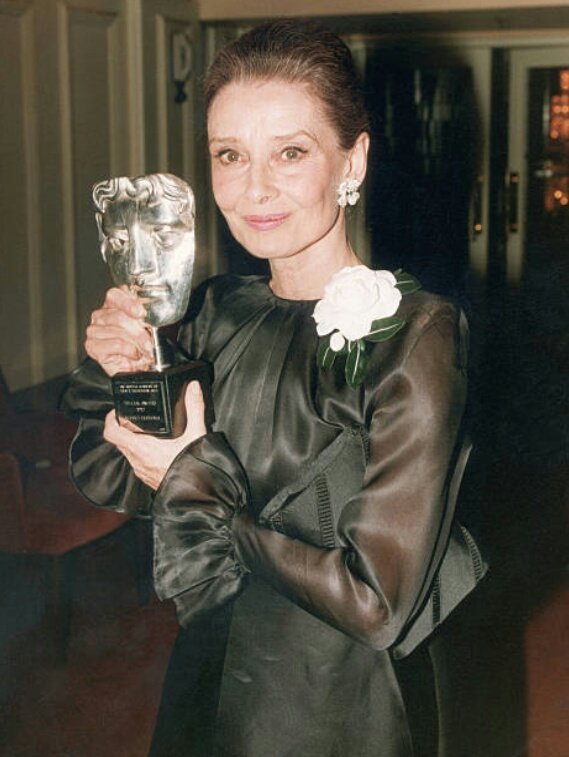
Audrey Hepburn receiving the BAFTA Lifetime Achievement Award in 1992.
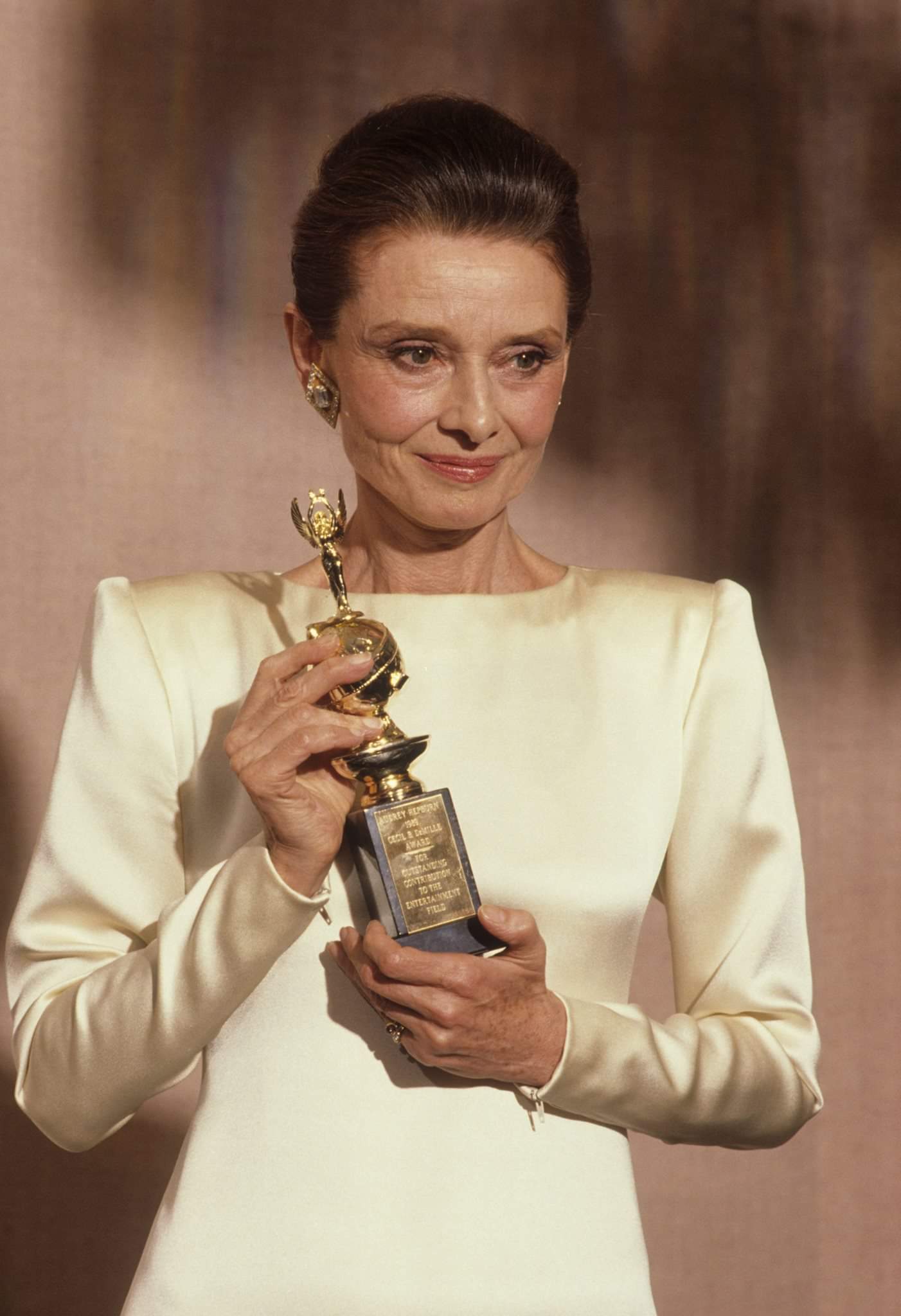
Audrey Hepburn receiving the Cecil B. deMille Award in 1990.
She has been the subject of many biographies since her death including the 2000 dramatisation of her life titled The Audrey Hepburn Story which starred Jennifer Love Hewitt and Emmy Rossum as the older and younger Hepburn respectively. Her son and granddaughter, Sean and Emma Ferrer, helped produce a biographical documentary directed by Helena Coan, entitled Audrey (2020). The film was released to positive reception. Hepburn's image is widely used in advertising campaigns across the world. In the United States, Hepburn was featured in a 2006 Gap commercial that used clips of her dancing from Funny Face, set to AC/DC's "Back in Black", with the tagline "It's Back – The Skinny Black Pant". On 4 May 2014, Google featured a doodle on its homepage on what would have been Hepburn's 85th birthday.
My mother would be the first person to say that she wasn't the best actress in the world. But she was a movie star.
Sean Ferrer, Hepburn's son
Style
Icon
Hepburn was known for her fashion choices and distinctive look, to the extent that journalist Mark Tungate has described her as a recognisable brand. When she first rose to stardom in Roman Holiday (1953), she was seen as an alternative feminine ideal that appealed more to women than men, compared to the more sexual and curvy Grace Kelly and Elizabeth Taylor. With her short hairstyle, thick eyebrows, slim body, and "gamine" looks, she presented a look that young women found easier to emulate than those of more sexual film stars. In 1954, fashion photographer Cecil Beaton declared Hepburn the "public embodiment of our new feminine ideal" in Vogue, and wrote that "Nobody ever looked like her before World War II ... Yet we recognise the rightness of this appearance in relation to our historical needs. The proof is that thousands of imitations have appeared." The magazine and its British version frequently reported on her style throughout the following decade. Alongside model Twiggy, Hepburn has been cited as one of the key public figures who made being very slim fashionable. Vogue has referred to her as "the acme of classic beauty".
Added to the International Best Dressed List in 1961, Hepburn was associated with a minimalistic style, usually wearing clothes with simple silhouettes that emphasised her slim body, such as monochromatic colours with occasional statement accessories. In the late 1950s, Audrey Hepburn popularised plain black leggings. Hepburn was in particular associated with French fashion designer Hubert de Givenchy, who was first hired to design her on-screen wardrobe for her second Hollywood film, Sabrina (1954), when she was still unknown as a film actor and he a young couturier just starting his fashion house. Although initially disappointed that "Miss Hepburn" was not Katharine Hepburn as he had mistakenly thought, Givenchy and Hepburn formed a life-long friendship.
In addition to Sabrina, Givenchy designed her costumes for Love in the Afternoon (1957), Breakfast at Tiffany's (1961), Funny Face (1957), Charade (1963), Paris When It Sizzles (1964), and How to Steal a Million (1966), as well as clothing her off screen. In addition to her partnership with Givenchy, Hepburn was credited with boosting the sales of Burberry trench coats when she wore one in Breakfast at Tiffany's, and was associated with Italian footwear brand Tod's.
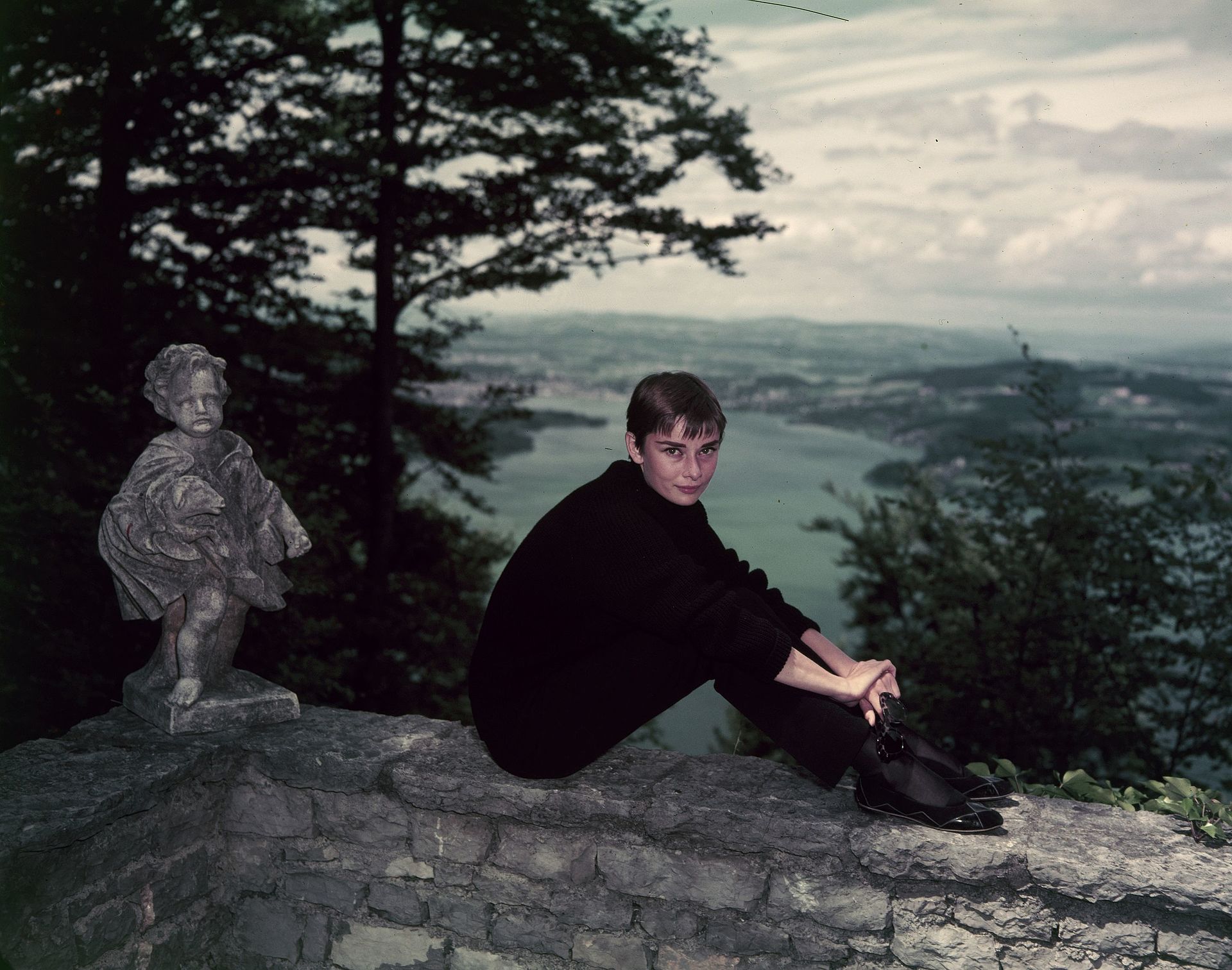
Hepburn with a short hairstyle and wearing one of her signature looks: black turtleneck, slim black trousers, and ballet flats, 1956. (Comet Photo AG)
In her private life, Hepburn preferred to wear casual and comfortable clothes, contrary to the haute couture she wore on screen and at public events.
My look is attainable ... Women can look like Audrey Hepburn by flipping out their hair, buying the large glasses and the little sleeveless dresses.
Hepburn's influence as a style icon still continues several decades after the height of her acting career in the 1950s and 1960s. Moseley notes that especially after her death in 1993, she became increasingly admired, with magazines frequently advising readers on how to get her look, and fashion designers using her as inspiration. Throughout her career and after her death, Hepburn received numerous accolades for her stylish appearance and attractiveness. For example, she was named the "most beautiful woman of all time" and "most beautiful woman of the 20th century" in polls by Evian and QVC respectively, and in 2015, was voted "the most stylish Brit of all time" in a poll commissioned by Samsung. Her film costumes fetch large sums of money in auctions: one of the "little black dresses" designed by Givenchy for Breakfast at Tiffany's was sold by Christie's for a record sum of £467,200 in 2006.